

The History of the Zanesville Museum of Art

Portrait of Edward Ayers, Founder, Zanesville Museum of Art,
A Vision for Art and Community
The story of the Zanesville Museum of Art begins with an ambitious idea: Zanesville should have a place where art, education, and community come together.
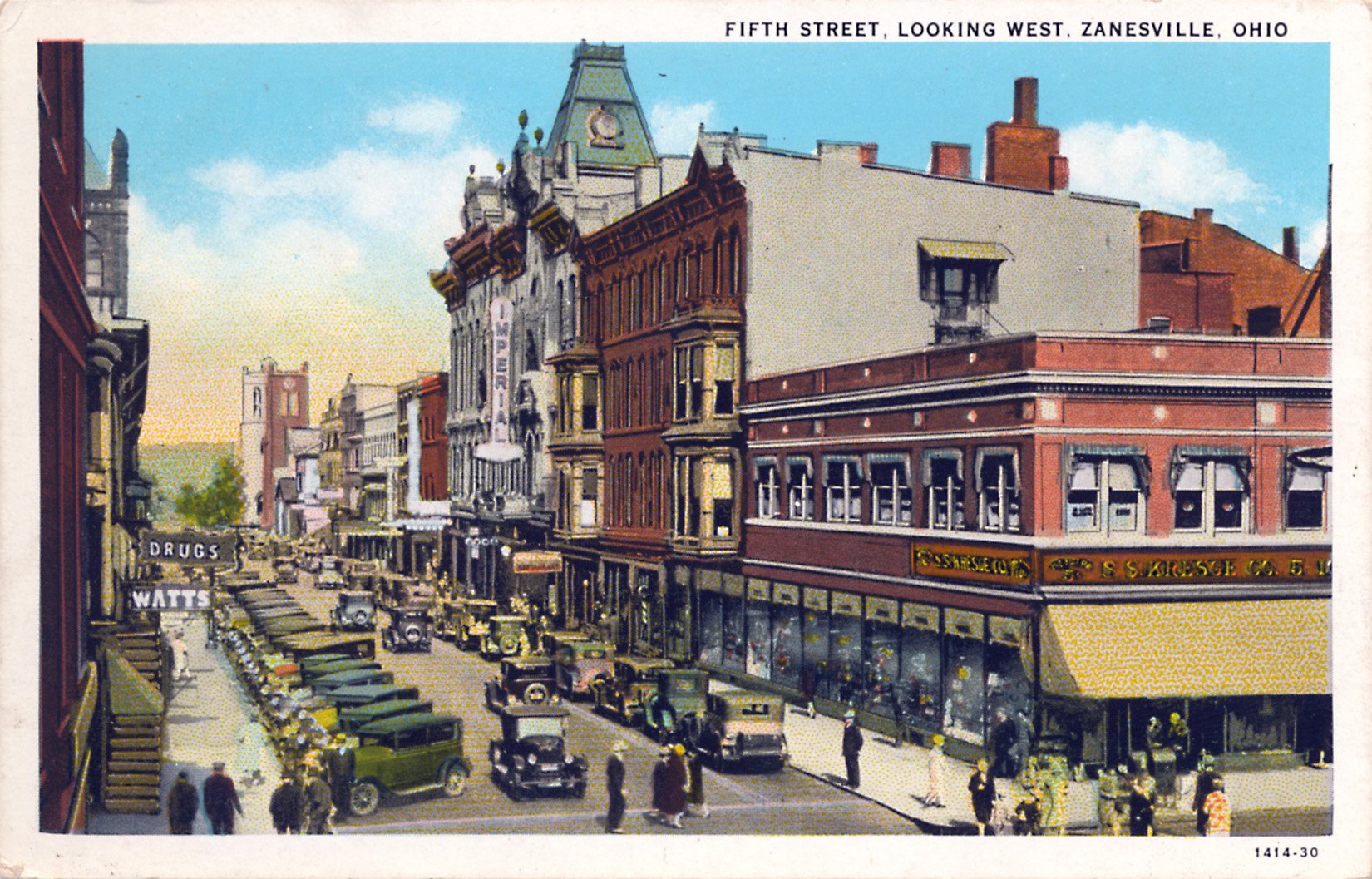
Downtown Zanesville, Ohio, 5th Street, Circa 1910
In 1933, Zanesville industrialists and philanthropists Edward M. and Klara K. Ayers commissioned A Cultural Survey of Zanesville, Ohio with Recommendations for a Civic Art Centre. Their vision grew from a community whose history was already deeply connected to art, creativity, and industry.
At the beginning of the twentieth century, Zanesville was a thriving manufacturing center. Located approximately 55 miles east of Columbus, the city benefited from abundant deposits of clay and silica, as well as rivers and railroads that connected local manufacturers to national markets.
These resources helped transform Zanesville and the surrounding region into one of America's most important centers for ceramic production.
Art Pottery Built Zanesville
By the 1920s, Zanesville was nationally known for the production of art, utilitarian, architectural, and industrial ceramics. Major manufacturers included the S.A. Weller Pottery Company, J.B. Owens Pottery Company, Roseville Pottery Company, American Encaustic Tiling Company, and Mosaic Tile Company.
These companies did more than manufacture pottery. They created jobs, generated wealth, attracted talented artists and designers, and helped establish a creative identity that continues to distinguish the region today.

Weller Pottery Company, Postcard, Circa 1900
The 1933 cultural survey recognized the importance of this artistic and industrial heritage. Building upon its recommendations, an ambitious architectural Master Plan was developed in 1934 for a cultural arts center in McIntire Park, just north of downtown Zanesville.

Zanesville Art Institute, Circa 1940, Located at the corner of Adair and Maple Avenues.
Although never realized, the plan was remarkably forward-looking. It envisioned visual and performing arts facilities surrounded by green space, a sculpture garden, walking paths, recreational areas, and an outdoor performance venue.
The Zanesville Art Institute
The Ayers did not allow the unrealized civic arts center to end their vision.
In 1936, Edward and Klara Ayers founded the Zanesville Art Institute (ZAI). They donated artwork, provided an endowment, and gave a Renaissance Revival residence at the corner of Maple and Adair Avenues that was adapted to serve as the Institute's first home.
From its beginning, the Institute was created for the public. It offered free admission, exhibitions, art classes, performances, and cultural programs.

The Ayers' collection included regional glass and ceramics alongside American and European paintings, sculpture, and works on paper. Works associated with artists including Peter Paul Rubens, Hiram Powers, David Teniers the Younger, Paulus Moreelse, and Thomas Gainsborough were displayed within an imported seventeenth-century English paneled room.
For the next four decades, the Zanesville Art Institute became a cornerstone of the community's cultural life, at times welcoming as many as 22,000 visitors annually. The Institute continued to grow even as Zanesville's industrial landscape changed dramatically following World War II and many of the region's ceramic manufacturers eventually closed.
A New Home
By the 1970s, the Institute had outgrown its original home.
In 1974, the ZAI launched its first major fundraising campaign, raising approximately $300,000 toward relocation. The following year, the Institute sold its Maple and Adair Avenue property and purchased a spacious residence situated on five acres at 620 Military Road.
After extensive renovations, the new facility opened in 1977 as the Zanesville Art Center (ZAC).
Growth continued. In November 1983, the Art Center launched another fundraising campaign, raising approximately $350,000 for expansion. Construction began in 1984, and in July 1985 the Art Center reopened with a new 7,000-square-foot south wing, providing additional space for exhibitions, educational programs, and collections storage.

The original Dunlop house, located at 620 Military Road.
Building a Larger Museum
By the turn of the twenty-first century, the Art Center was again looking toward its future.
In 2000, ZAC launched its third major fundraising campaign to expand the Museum. By September 2001, the organization had raised approximately $1.9 million and secured additional financing for the project.
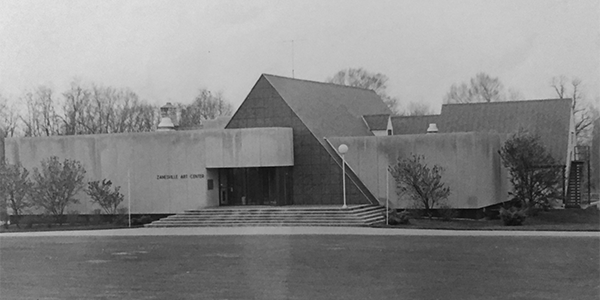
The Zanesville Art Center in 1977, after the house was remodeled.
Completed in 2003, a major three-story addition significantly expanded galleries, collections storage, and public spaces. The resulting approximately 30,000-square-foot facility provided a much larger home for the Museum's growing collection, exhibitions, educational programs, and community events.
In 2008, the Zanesville Art Center officially became the Zanesville Museum of Art (ZMA), reflecting the institution's evolution from a community art center into a collecting and exhibiting museum.
Challenge, Renewal, and Reconnection
The Great Recession of 2007–2009 created significant financial challenges for the Museum. ZMA reduced expenses and made difficult decisions to stabilize operations and strengthen its financial position. While these efforts helped address immediate financial pressures, facility maintenance was deferred, programs were reduced, and attendance declined.
By 2013, annual attendance had fallen to approximately 3,000 visitors. The Museum faced an important question: How could it reconnect with the community it was created to serve?
Beginning in 2014, ZMA entered a period of institutional renewal.
Through strategic planning and organizational self-study, the Museum strengthened its financial position, expanded staffing, addressed deferred facility maintenance, increased exhibitions and educational offerings, and placed renewed emphasis on accessibility and community engagement.
New free and low-cost programs—including lectures, classes, workshops, children's programs, summer camps, special events, and school initiatives—created more opportunities for people of all ages to experience the Museum.

Demolition during one of the remodels.
ZMA also strengthened partnerships with educational, cultural, civic, and social-service organizations throughout Zanesville, Muskingum County, and the region. These relationships helped extend the Museum's reach and reconnect ZMA with the broader community.
A Museum Without Walls
On March 14, 2020, ZMA temporarily closed to the public in response to the COVID-19 pandemic.
But the Museum's work did not stop.
Within days, ZMA began developing online programs, exhibitions, and events. Museum staff were retained and redirected toward a major collections digitization and inventory initiative. This work significantly expanded digital access to the permanent collection and helped create a searchable online collections resource.
What began as an extraordinary challenge became another opportunity to reconsider how the Museum could serve its community and prepare for the future.
Celebrating 90 Years—and Imagining What Comes Next
In 2026, the Zanesville Museum of Art celebrates its 90th anniversary.
The milestone provides an opportunity to celebrate an extraordinary legacy—but also to look forward.
The same spirit of imagination that inspired Edward and Klara Ayers in 1933 continues to guide the Museum today. Nearly a century after Zanesville's first cultural survey and Master Plan envisioned an ambitious center for art and community, ZMA is once again undertaking a Master Planning process to consider the Museum's future.
The new plan will examine the Museum's galleries, collections, educational spaces, facilities, staffing, visitor experience, financial resources, and community needs and establish a realistic roadmap for the years ahead.
At the center of that future is ZMA's increasingly important role as a steward and interpreter of American art pottery and the extraordinary ceramic heritage of Zanesville and Ohio. This regional story has national significance, and the Museum is uniquely positioned to preserve it, study it, exhibit it, and introduce it to new generations.
The institution has changed considerably since the doors of the Zanesville Art Institute first opened in 1936. What has not changed is the fundamental idea behind it:
Art belongs in the life of the community.
As ZMA celebrates 90 years, we honor the people who built this institution, welcome the community it serves today, and begin imagining the Museum that will serve generations to come.
Our first 90 years created the foundation. Our next chapter begins now.